Some of the best overtakes in a race happen with nobody side by side. One car turns into the pit lane, the other stays out, and a lap later the order has flipped. Here’s how that works, and how it plays out when twenty-two computer drivers race for real.
The undercutStop first, win the place on new tyres.The car behind pits early and laps faster while its rival does one more lap on worn tyres.
The overcutStay out, win the place on clear road.It works when new tyres are slow to warm up, or the early stopper rejoins in traffic.
What decides itTyre advantage against the gap.Pit loss is the same for both cars. The out-lap, the in-lap and traffic settle it.
In real racing
Overtaking on track is hard. On many circuits the car behind can be faster and still spend lap after lap stuck a second back, unable to make a move stick. So teams look for another way past, and the pit stops offer one. This is the first part of my five-part series on racecraft, and it starts in the pit lane.
What pit loss is
Every stop costs time, and not just the time spent stationary. A car in the pit lane is held to a speed limit, while a car on the circuit races past at full speed. Add the seconds stopped in the box, and the slower run back up to racing speed, and you have the pit loss: how far behind a car rejoins compared with where it would have been if it had stayed out.
It varies hugely. A short pit lane with a generous speed limit might cost fifteen seconds; a long one at a tight limit can cost thirty or more. The numbers depend on the circuit, the series and its rules, so treat any single figure with suspicion. The easiest way to picture it is a ghost: the same car, staying on the circuit, at the same pace.
Pit loss: a car and its ghostIllustration
In the pit lane, held to the speed limit
Behind its ghost0.0s
Slower in the lane
—
Stopped in the box
—
Pit loss
—
Pit lane speed limit
The purple car takes the pit lane; its ghost stays on the circuit. When the car rejoins, the distance to the ghost is the pit loss. Change the speed limit or the stop and watch the gap move.
Why fresh tyres are faster
A racing tyre is at its best when it’s new and slowly loses grip as it wears. By the end of a stint a car might be a second or more a lap slower than it would be on a fresh set. That difference, the tyre delta, is what the whole game is about. (Part two goes deep on compounds and wear.)
Two laps matter most. The in-lap is the last lap before a stop, driven on the oldest tyres the car will use. The out-lap is the first lap after it, starting from the pit exit on brand-new rubber. When two cars stop a lap apart, one car’s out-lap is run at the same time as the other’s last lap on old tyres. The difference between those two laps is the swing.
One lap, two carsIllustration
Varela has just stopped. Okonkwo, who was ahead, is still out on old tyres. Same lap, sector by sector.
VarelaOut-lap · new hards
———0.0s
OkonkwoSame lap · old mediums
———0.0s
The swing on this lap…Running the lap
Green sector times are the quicker of the two. Warm tyres give the car that stopped first a big swing; cold ones can hand it straight back.
How the undercut works
Say one car is running 1.5 seconds behind another, with both sets of tyres fading. The car behind pits first. Both cars will pay roughly the same pit loss in the end, so it cancels out. What doesn’t cancel is the lap or two in between: the car that stopped first laps on new tyres while its rival laps on worn ones, then does its in-lap on the oldest tyres of all.
If that swing is bigger than the gap between them, the car that stopped first comes out of the exchange ahead. Nobody needed to overtake on track. That’s the undercut, and it’s usually what the car behind is trying when it pits earlier than expected.
It has a defence. If the car in front reacts and pits on the very next lap, it limits the damage. Teams call this covering the stop. The catch is that covering means stopping earlier than planned, so the leading car may then have to make its new tyres last longer than it wanted to.
When the overcut works instead
The overcut is the opposite play: stay out longer and gain while the rival is on fresh tyres. It sounds backwards, but it works more often than you’d think. The usual reasons:
Tyres that are slow to warm up. New tyres come out of the pits below their working temperature. On a cold day, or with a hard compound, the out-lap can be slower than a lap on warm old tyres.
Traffic on rejoin. If the early stopper comes out behind slower cars, the new tyres are wasted queueing.
Old tyres that are still good. If wear is gentle, the car staying out loses little by waiting.
Clear air. Once its rival has stopped, the car staying out often has empty road and can push.
Most of the time, the decision comes down to a few numbers set against each other. Here they are as a balance.
What decides itIllustration · a simplified sum
Stopping first gains—
The gap to beat—
—
One lap between the two stops, and the same pit loss for both cars, so it drops out of the sum. Real races add fuel, tyre choice and luck, but these four usually decide it.
The undercut and overcut, lap by lap
On a timing screen, both moves look like lap times crossing. Here’s the same pair of cars both ways. Watch the bottom row: the net gap, with both stops counted.
Lap times and the net gapIllustration
Okonkwo starts ahead
Varela stops first
After lap 1—
Lower on the chart is faster. The pit stop itself isn’t drawn, since both cars pay it. Click any lap to stop there.
In Little Engines
Little Engines is a race broadcast simulator: 22 computer-driven cars race for real, and you watch it all unfold with a director, a commentary booth and a timing tower. Nobody scripts the pit stops, so the undercut and overcut happen when the race makes them possible. Here’s how I built that, and where it is simpler than the real thing.
Pit loss on every circuit
Pit loss in Little Engines is worked out per circuit from the pit lane itself: the time to drive the lane at its speed limit against the stretch of circuit it bypasses, the stop, and the run back up to speed. A circuit without a drawn lane gets an average figure, and no stop costs less than seven seconds. Races are short, so the losses are smaller than in most real series: at Pukka Raceway a stop costs around eleven or twelve seconds.
Time in the box depends on how worn the tyres are, from about three seconds on a barely used set up to eight on a finished one, plus extra time to fix a damaged front wing. The pre-race circuit guide shows each venue’s pit loss, and the booth mentions it as the field’s strategies are previewed.
How the computer drivers decide
Before the lights go out, every driver has a planned strategy, built from the same tyre-wear and pit-loss maths. Most of the field takes the fewest stops that are competitive. In the standard and long race lengths, the rules ask each car to use two dry compounds.
During the race, the pit wall treats the plan as a target, not a timetable. Two simple rules turn it into racecraft:
The pit wall’s two rulesIn Little Engines
UndercutStop a lap early
Due in next lap
Within about 2.5 seconds of the car ahead
Tyres at least 42% worn
The car ahead hasn’t stopped
OvercutStay out one more lap
Due in this lap
The car ahead, within about 2.5 seconds, has just turned in
Tyres less than 72% worn
The two pit-window rules every computer driver follows in Little Engines. Damage and worn-out tyres override both: a car that has to stop, stops.
Those rules are deliberately small, and they don’t cover everything a real strategist would think about. There’s no reflex to cover a rival’s stop: a car being undercut doesn’t automatically pit next lap in response, unless its own plan says so.
Warm-up does exist. With incidents switched on (the default is Normal), new tyres leave the box below their working temperature and take most of the out-lap to come in, costing grip until they do. That makes the overcut genuinely possible. The strategy maths doesn’t try to predict warm-up, though, so the computer drivers don’t pick the overcut because of cold tyres. They try it when the gap and the wear say so, and the warm-up decides whether it pays. Traffic at the pit exit is real too: a car rejoining alongside another eases in more slowly, and a car leaving its box waits if another is coming down the lane.
What you see on the broadcast
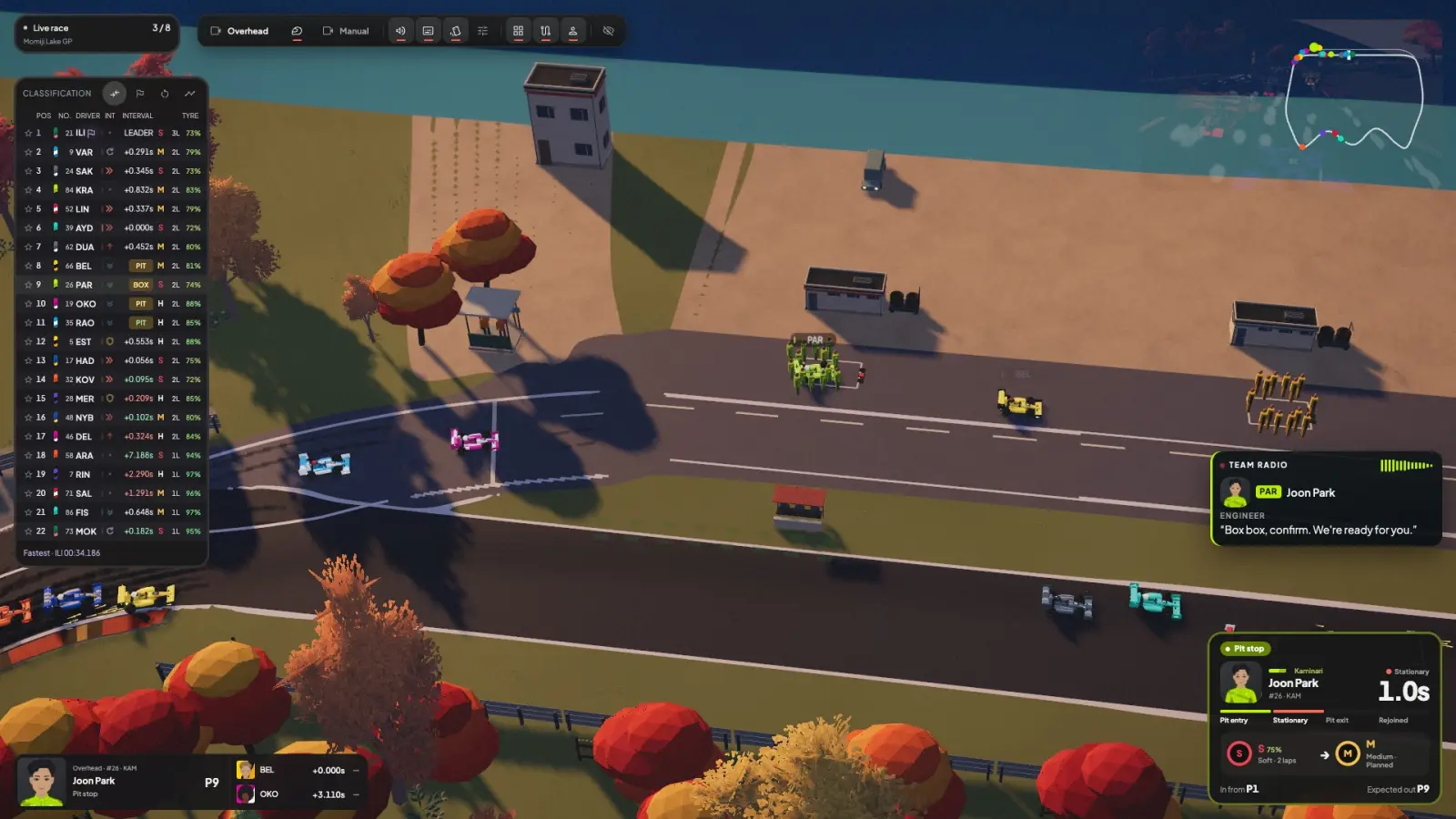
All of this is told rather than hidden. When a car stops, the pit card follows it from pit entry to stationary to pit exit to rejoined, with the tyres coming off and going on and the place it’s expected to come out in, estimated from the gaps and the circuit’s pit loss. The timing tower marks it PIT, then OUT LAP.
An undercut on the broadcast · lap 9In Little Engines · mock-up
Timing tower
A mock-up built from the game’s own cards and recorded lines, with illustrative times. Click the dots to step through.
If the director is following a car when it stops, the picture stays with the stop until the car has rejoined, and a couple of seconds more to see it settle in. Only the race being decided, or an incident at the front, takes the camera away sooner.
The voices join in. If you’re following a car and the one just behind it pits, close enough to threaten, its engineer comes on the radio to warn of the undercut. If it works anyway, the driver lets the team know. The booth calls what each stop is for as it happens, but it waits until both cars have stopped before naming the result, so it never calls an undercut that didn’t happen. When a pit exchange changes the order, or an attempt falls short, a card shows the gap before the stops against the gap now, with a verdict: undercut works, overcut works or undercut falls short.
That’s the bit I’m proudest of. Nobody told the race to have an undercut on lap nine. Two computer drivers were close, one pit wall saw a chance, and the broadcast noticed. Next in the series: racing tyre strategy, where the tyre delta behind all of this comes from.
The undercut, side by sideReal racing · Little Engines
The questionIn real racingIn Little EnginesHow big is the pit loss?Often around 15–30 seconds, varying by circuit and series.Worked out per circuit from the pit lane; smaller, as the races are short. Never under seven seconds.Who decides to undercut?Strategists on the pit wall, with live data and the driver’s feedback.Each computer driver’s pit wall, using two simple rules on gap and tyre wear around a planned stop.Covering a rival’s stopA common defence: pit next lap to limit the damage.Not modelled as a reflex. A car only stops when its own plan or tyres say so.Cold tyres after a stopVaries with compound, temperature and circuit; central to the overcut.Modelled when incidents are on: new tyres lose grip until they warm. Strategy doesn’t predict it.Traffic on rejoinTeams time stops to find a gap in the traffic.Rejoining cars ease in around traffic, but stops aren’t timed to find gaps.How you follow itTiming screens, team radio and commentary.Pit and verdict cards, the timing tower, team radio and a live booth that waits for the result.
The same idea in both worlds. Little Engines keeps the principle and simplifies the decision.
FAQ
Questions about the undercut and overcut
What is an undercut in racing?
An undercut is passing a rival in the pit stops rather than on track. The car behind pits first, uses the extra pace of fresh tyres while the rival does another lap on worn ones, and is ahead once the rival has made its own stop.
What is the difference between an undercut and an overcut?
With an undercut you stop first and gain on the out-lap with new tyres. With an overcut you stay out longer and gain while your rival is on cold new tyres or stuck in traffic. Which one works depends on how big the new-tyre advantage is, how quickly tyres warm up and where each car rejoins.
What is pit loss?
Pit loss is the time a pit stop costs compared with staying out: driving the pit lane at its speed limit instead of racing past it on the circuit, plus the time stopped in the box. It varies a lot from circuit to circuit and series to series, often somewhere between about fifteen and thirty seconds.
Do the computer drivers in Little Engines use the undercut?
Yes. Each computer driver starts with a planned stop, and the pit wall treats it as a target. Running within about 2.5 seconds of the car ahead with a worn set, a driver will stop a lap early to undercut it. If the car ahead stops first and the tyres are still healthy, the driver stays out a lap to try the overcut. You simply watch it play out on the broadcast.
Where can I get Little Engines?
Little Engines is coming to Steam for Windows, macOS and Linux. Sign up for updates to hear when the Steam page and demo open.
Take the best seat in the house.
Little Engines is coming to Steam for Windows, macOS and Linux. Get one email when the Steam page opens, one when the demo lands and one on launch day.