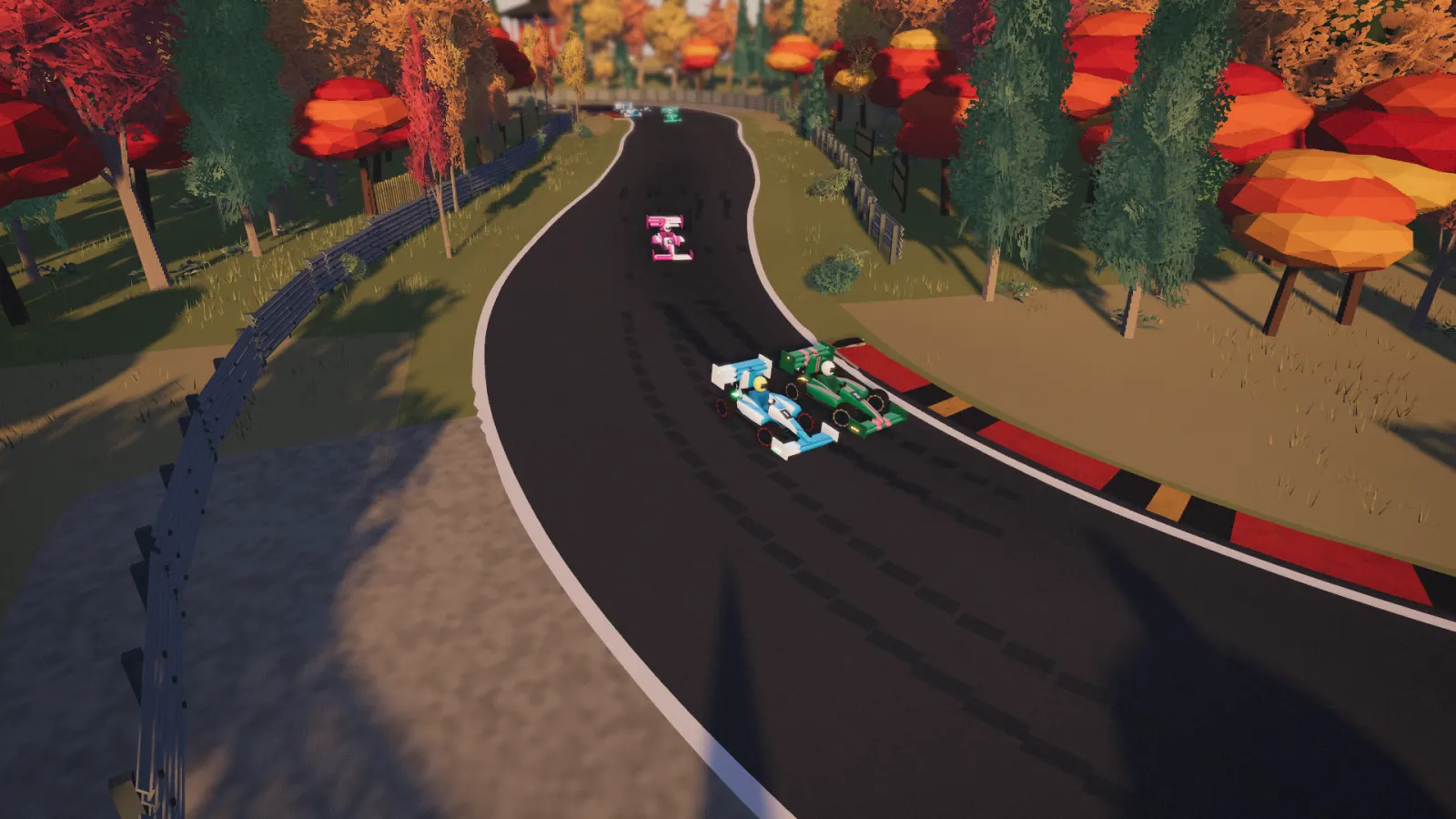
How racing drivers overtake, and how my computer drivers learnt to
The best thing to watch in any race is a pass building. A car closes in, sits in the tow for a lap or two, feints, and then one braking zone it’s alongside. Here’s how real drivers make that happen, and how I taught my computer drivers to do it for themselves.
Where passes happenMostly under brakingThe car that brakes later and gets alongside before the corner usually wins it.
The key momentThe overlapOnce the cars overlap, the corner is shared and the defender has to leave room.
In Little EnginesPressure, then commitmentComputer drivers build readiness behind a slower car, then commit to a side.
In real racing
A pass starts laps before it happens
Overtaking looks like a single moment, but it rarely is. A driver who is quicker than the car ahead still has to turn that pace into a place, and the car ahead is doing everything it can to stop it. So a pass is usually built over several corners.
First comes closing in. The chaser needs to be close enough to strike in the next braking zone, ideally within a car length or two at the end of a straight. That’s where the slipstream helps: tucked into the hole in the air behind the leader, the chaser gains speed and reels the gap in. The catch is the corners. In the turbulent wake the chaser loses grip and its tyres run hot, so it can’t sit there for ever.
Then comes setting it up. The chaser studies where the car ahead is weak. Perhaps it brakes early into the hairpin, or gets a poor exit out of the last corner. A good driver shows a nose, pulls back, and shows it again, making the defender think about the wrong corner. Then, when the gap and the run are right, it commits.
Anatomy of a pass under brakingReal racecraft · illustration
Close in
Set it up
Brake later
Overlap
Done
Aydin is quicker and closing. He tucks in behind Delorme, in range for the next braking zone.
The red flash is each car’s brake light; the boards count down to the corner in metres. The attacker never out-accelerates the car ahead here. He wins the place in the few metres he brakes later.
Why most passes happen under braking
On a straight, two similar cars are going roughly the same speed, so getting past means having a much faster car. Braking zones are different. Every driver has a marker where they start braking, and the difference between a safe marker and a brave one is worth several metres. Brake a little later than the car ahead, on a different line, and you arrive at the corner alongside it.
That is the moment that matters: the overlap. Once the attacker’s front wheels are level with some part of the other car before it turns in, the corner belongs to both of them. The defender can’t simply turn in on the racing line, because the other car is there. It has to leave room, and the attacker, on the inside, has the shorter way round.
The cost is the exit. Braking late and diving to the inside means a tighter, slower line out of the corner. The attacker only needs to be ahead at the apex and hold position on the way out. Get the braking wrong, though, and it slides wide, leaving the door open for an instant counter-attack.
The main overtaking moves
Almost every pass is a variation on a handful of moves. The inside line under braking is the classic. A pass round the outside is rarer and braver: when the defender has covered the inside, the attacker carries more speed on a wider arc and hopes to be alongside on the exit, ready to have the inside for the next corner. And the switchback, or cross-over, is the reply to a late lunge: let the other car dive in and run deep, turn in later, cut back underneath and use the better exit to come back past on the straight.
There’s also the drag race. Get a cleaner exit out of a slow corner, pull alongside on the straight, and the move is finished in the next braking zone. And sometimes no move is needed at all: in a pit-stop race, the place can be won in the pit lane instead, which I covered in the undercut and overcut.
Three ways pastReal racecraft · illustration
Move
The classic. Get alongside on the inside under braking and the corner is yours, because the car ahead has to leave room or hit you.
Pick a move to replay it. The dashed line is the fastest single-car line; every pass trades some of that speed for position.
Defending, and leaving a car’s width
The driver in front isn’t a passive obstacle. The simplest defence is covering the inside: move across before the braking zone so there’s no room to dive into. It works, but it costs speed. Turning in from the inside means a tighter, slower corner, which can hand the chaser a better exit and a run on the next straight.
The alternative is to hold the racing line, take the fastest corner possible and trust the gap. That leaves the inside open for a brave lunge, but makes any pass harder to complete.
Every series has its own rules, but the common principles are similar. A defender may make one move to cover a line, made early, not in the braking zone, and no weaving. And once an attacker has a real overlap, the defender must leave at least a car’s width of room on track. Squeeze a car that’s alongside off the road and the stewards will usually have something to say.
Sometimes the smartest defence is not defending at all. If the car behind is far quicker, fighting for every corner just cooks the tyres and loses time to the cars further back. Letting it go and getting back to your own race can be worth more than the place.
In Little Engines
Reading the road, every moment
None of this is scripted in Little Engines. All 22 computer drivers race each other for real, and the passes you watch are ones they decided to make. Teaching them was most of the work of making a race worth watching.
Every moment, each computer driver rebuilds its picture of the cars around it from scratch: the gap to each one, how fast it’s closing, whether the cars overlap, who is a threat and who is an opportunity. A rival only counts as an opportunity if the driver has real pace in hand. Closing speed under braking spikes for a moment in every braking zone, so the drivers ignore those spikes and look for a sustained speed advantage instead.
From there, each driver runs in one of a few modes: conserving, following, pressuring, attacking, recovering, defending or conceding. On the broadcast, the timing tower shows a small symbol next to drivers who are attacking, defending, pushing, conserving or recovering, so you can see a fight forming before the cameras find it.
Pressure, then commitment
A pass in Little Engines builds the way a real one does. Once a driver is within about 28 metres of a slower car, it starts building readiness for a move. How fast that builds depends on its aggression, how much quicker it is, and how urgent things are: the last two laps make everyone keener. How much it needs to protect its tyres slows it down and raises the bar. When readiness crosses the threshold, and the pace advantage is big enough, the driver commits.
Plenty can stop it first. Sitting in dirty air heats the tyres, and past a limit the chaser drops back to let them cool, unless it’s on fresher tyres and has grip to spare. A rival that is about to pit isn’t worth a fight, so appetite drops. And under yellow flags or a slow zone, nobody starts a new move.
Inside a computer driver’s headLittle Engines · illustration
Driver
Within reach
Pace in hand
Time held up
Tyre heat
Mistake risk
Readiness for a move
Decision
Following
The same chase, two temperaments. Varela is aggressive and hard on his tyres, so readiness builds fast against a low bar. Fischer is patient and protective, so her bar is higher and her tyres overheat first. The shape follows the game’s logic; the numbers are illustrative.
Braking later, and picking a side
A committed driver does what a real one does: it pulls out and brakes later. It only does that with a rival within about seven metres, and it brakes less deeply into tighter corners, where a lunge is riskier. Aggressive drivers push the braking point deeper.
The side matters too. Drivers prefer the inside of the coming corner relative to the car they are passing, but an inside that is already taken never beats an outside that is clear. If an attempt fails, the next one leans to the other side. Behind the scenes, the drivers weigh 32 possible lines against every car around them at once, so they commit to one line through a group rather than darting at each car in turn.
Not every attempt works. If a move hasn’t stuck after a second and a half, the attacker backs off, recovers and remembers that rival for somewhere between 10 and 28 seconds. It won’t try the same car again in that window unless a much better chance turns up, such as a mistake. That’s what gives battles their rhythm on the broadcast: a lunge, a pause, a second go a lap later.
Each driver is also stronger in some corners and weaker in others, so the same corners tend to produce the passes, much as they would at a real circuit. That isn’t a named move, and I haven’t programmed a switchback as a manoeuvre. Moves like it come out of the drivers reading the road.
Defending, and leaving room
The drivers defend by the same principles as real ones. A defender covers the inside before the braking point, only into a corner and never on a straight, and it picks the side from the shape of the road rather than copying the car behind. It can only cover so many times before its budget runs out, and it never starts a fresh swerve once it’s in the bend.
Once the attacker has an overlap, the defender holds its line and doesn’t add a block. Pressure from behind doesn’t own road space; only a car alongside does. Where the road is wide enough for two, both cars race it, and a committed driver will run two-wide through a gap a timid one would give up.
Cover, or hold the line?Little Engines · illustration
Defence
Covering: Delorme moves to the inside while still on the straight, before the brakes go on. The door is shut, at the cost of a slower corner.
The replay alternates between the two choices until you pick one. A computer defender covers early or not at all: once the corner begins, it holds its line.
Defending has a price. The game’s mistake risk rises for a risky overtake and for a driver defending under pressure, and the defender carries the larger share. So a driver being caught by a clearly faster car, where covering would cook its tyres, concedes and lets it through. Lapped cars yield to the leaders under blue flags, and composed, patient drivers yield more cleanly.
What you see on the broadcast
All of this is there for you to watch. The tower symbols show who is attacking and who is defending, and the cars’ rear lights glow green on an attacking car and amber on a defending one, so you can read a fight from the Overhead or Chase camera at a glance. The director treats a building battle as the shot before anyone has made a move, which I’ll come to in part five. And a pass only counts once it has held for a second and a half: two cars swapping back and forth through a corner is a battle, not two passes.
Real racing vs Little EnginesSide by side
The questionIn real racingIn Little EnginesHow a pass startsClose in, use the tow, set it up over a few corners.Readiness builds within about 28 m of a slower car, faster for aggressive drivers, slower for tyre savers.Where moves happenMostly under braking, often in the same few corners.Under braking, with a later braking point; each driver has strong and weak corners.Picking a sideUsually the inside; the outside when it’s covered; a switchback in reply.Prefers the inside, takes a clear outside over a blocked inside, switches sides after a failed try.DefendingOne move, made early, no weaving, and a car’s width once overlapped.Covers before the braking point, never on a straight, a limited number of times; holds its line once overlapped.Letting a car bySometimes wiser than fighting a much faster car.Concedes to a clearly faster car when covering would cook its tyres.When a pass countsWhen the attacker is clearly ahead and stays there.After it holds for 1.5 seconds; a swap straight back cancels both moves.
The drivers learnt the shape of real racecraft: pressure, commitment, overlap and room. There are no named moves; it all comes out of how they read the road.
FAQ
Questions about overtaking
How do racing drivers overtake?
Most passes happen under braking. The chasing driver closes in, often using the slipstream on a straight, pulls out, brakes later than the car ahead and gets alongside on the inside before the corner. Once the cars overlap, the corner is shared and the defender has to leave room. Passes round the outside, switchbacks and drag races out of a slow corner are the other main moves.
What is a switchback in racing?
A switchback, or cross-over, is a counter-move. When a rival dives up the inside and runs deep into a corner, the driver who was passed turns in later, cuts back underneath on the exit and uses the better drive out of the corner to retake the place on the next straight.
What are the rules for defending in motor racing?
They vary between series, but the common principles are similar. A defender may make one move to cover a line, made early and not in the braking zone, and must not weave. Once an attacker has a meaningful overlap, the defender must leave at least a car’s width of room on track.
How do the computer drivers in Little Engines decide when to overtake?
Every moment, each computer driver reads the gap, the closing speed and any overlap with the cars around it. Close behind a slower car, it builds up readiness for a move at a rate set by its aggression, its pace advantage and the laps left, held back by how much it needs to protect its tyres. When readiness passes its threshold it commits: it pulls out, picks a side and brakes later. A failed attempt makes it back off and remember that rival for a while.
Where can I get Little Engines?
Little Engines is coming to Steam for Windows, macOS and Linux. Sign up for updates to hear when the Steam page and demo open.
Take the best seat in the house.
Little Engines is coming to Steam for Windows, macOS and Linux. Get one email when the Steam page opens, one when the demo lands and one on launch day.