Racing tyre strategy, explained: soft, medium, hard and wet
Watch a race closely and the tyres are telling a story the whole time: who is fast now, who will be fast later, and who has already decided when to stop. Here is how to read it, and how that story unfolds in Little Engines.
CompoundsSoft is fast, hard lasts.Softer rubber grips harder and wears faster. Harder rubber gives up a little pace for a much longer life.
DegradationEvery lap costs a little.Lap times creep up as the rubber wears and heats, until many tyres fall off a cliff.
StopsOne stop or two is a sum.An extra stop pays only if fresher tyres win back more time than the pit lane costs.
In real racing
Tyres are the one part of a racing car that every team has to manage in public. Engines and wings are developed in private; tyres wear out in front of everyone, lap after lap. That’s why so many races are decided by a tyre call rather than an overtake. This is part two of my Racecraft explained series, and the first half is about racing in general.
Why racing tyres come in compounds
A racing slick has no tread. All of its grip comes from the rubber itself, warmed up until it’s sticky and pressed into the surface. The compound is the recipe for that rubber, and it sets the basic trade: softer rubber grips harder but wears faster; harder rubber is slower but lasts longer.
Most championships name their dry compounds soft, medium and hard, and usually mark them with a coloured stripe so you can tell them apart on television. Red, yellow and white is a common scheme. The exact range brought to each weekend varies by series and by circuit: a rough, abrasive surface calls for harder rubber than a smooth street circuit.
The difference is usually a few tenths of a second a lap when new. It’s small, but over a long run it adds up, and the soft spends its advantage quickly.
One stint, three sets of tyres · lap 1Illustration
SoftGrip100%Holding on
MediumGrip95%Holding on
HardGrip90%Holding on
An illustration, not data. The soft starts with the most grip and spends it fastest; the dashed line marks where the soft and medium fall off the cliff. The hard never gets there in this stint.
Degradation, wear and the cliff
Two words get used for a tyre getting older, and they aren’t quite the same thing. Wear is rubber physically leaving the tyre. Degradation is the lap time it costs. A tyre can wear without slowing much, and it can degrade without wearing much, if it overheats or the surface of the rubber tears and rolls up, which drivers call graining.
Heat is the thread running through all of it. Each compound has a working window of temperature. Below it the rubber is hard and slippery, which is why the first lap on new tyres is a nervous one. Above it the rubber goes greasy and wears faster. Following another car closely, pushing too hard or sliding all push a tyre out of its window. A driver who keeps the tyres in the window for longer has more to use at the end.
For most of a stint, degradation is gradual: a few hundredths here, a tenth there. Then, late in a tyre’s life, many compounds hit the cliff: the grip goes and lap times drop by seconds rather than tenths. Nobody wants to be out on track when it arrives, so a lot of strategy is really about predicting it.
One stop or two? It’s a sum
Every pit stop costs time: the slower drive down the pit lane, the stop itself and getting back up to speed, against a car that stayed out. Every stop also buys fresh tyres, which are faster than old ones. So the strategy question is a sum. An extra stop is worth it only if the fresher tyres win back more than the pit lane costs.
Two things tip the sum. A slow, long pit lane makes stops expensive and favours one stop. Heavy degradation makes old tyres slow and favours more stops. The figure below runs the same race both ways. Change the pit loss and the circuit and watch the winner flip.
One stop against two stopsIllustration · Little Engines tyre model
One stop
M · 7H · 8
Two stops
S · 4H · 7S · 4
One stop wins
The line is the two-stop car’s total race time minus the one-stop car’s, lap by lap. Each pit stop is a jump; fresher tyres are the slope back. The numbers come from the Little Engines tyre model on a 15-lap race, but the sum is the one every pit wall does.
Real strategy is messier than any one sum. A safety car can make a stop nearly free. Traffic can ruin a fast plan. And a rival stopping early can force a reply, which is the subject of part one, on the undercut and overcut.
Rules, rain and the crossover
Many championships add rules on top. Some require every driver to use at least two different dry compounds in a race, which forces at least one stop. Some fix which sets a driver must start on. The details vary from series to series, so it’s worth knowing which rules apply before judging a strategy.
Rain is a whole topic of its own, so I’ll keep it brief. Wet-weather tyres have grooves that clear water. Most series have two kinds: intermediates for a damp or drying track, and full wets for standing water. The crossover is the point where one tyre becomes quicker than the other, and teams watch lap times closely to find it. Switch too early and you are slow; switch too late and you may be off the road.
In Little Engines
Little Engines is a race broadcast simulator: 22 computer drivers race for real while you watch it unfold from the director’s chair. Tyres are one of the main things that make each race different, so I built them as a real system rather than a script. Everything in this half is how the game works, and where it differs from the real thing I’ll say so.
Four tyres, one honest curve
The game has three dry compounds, soft, medium and hard, plus one rain tyre called the wet. There is no intermediate. A soft grips 3.5% more than a medium when new and wears one and a half times as fast. A hard grips 3% less and wears at about two-thirds of the medium’s rate. In a standard-length race the medium is tuned to last about 60% of the distance, so a one-stop race is always on the table.
The four compoundsIn Little Engines · in-game numbers
SSoft
Grip when new
+3.5%
Wear rate
1.5×
Lasts about 40% of a standard race. Working window 82–104 °C.
MMedium
Grip when new
Baseline
Wear rate
1×
Lasts about 60% of a standard race. Working window 88–110 °C.
HHard
Grip when new
−3%
Wear rate
0.66×
Lasts nearly all of a standard race. Working window 94–116 °C.
WWet
Grip lost when soaked
3% · slicks 18%
Grip lost when dry
7%
Wears up to 3.4× faster as a line dries. Working window 55–85 °C.
Straight from the game’s compound table. “Lasts” means reaching 75% wear, the furthest the computer drivers will plan a stint, at an average driver’s rate.
Grip fades along one smooth curve: a small linear term that makes degradation visible from the first laps, and a larger term on wear squared that grows as the tyre ages. That linear term is deliberate. On the broadcast I wanted lap times to start drifting early, so you can see a stint fading long before it matters.
That curve has no sudden cliff. The game steepens degradation instead of dropping it off an edge, which is a simplification of the real thing. Drag the lap marker below to see what each compound is doing at any point in a stint.
Lap time through a stint · lap 6In Little Engines · in-game numbers
SSoft
MMedium
HHard
The game’s planning model for a 15-lap race on an 800 m lap, fuel aside. The quickest compound on the chosen lap is highlighted; a dot marks the last lap before 75% wear, where the computer drivers plan to stop. Watch the soft lead early, then hand over.
Heat is modelled more simply than in real life. With incidents switched on, which is the default, each car has one tyre temperature against its compound’s working window. Fresh tyres leave the pits below the window and take a lap or so to come in. Pushing, sliding and running in another car’s dirty air heat them up; overheated tyres lose grip and wear faster. You can see the temperatures in the timing tower’s Condition view.
How the computer drivers plan a race
Before the lights go out, every computer driver picks a whole-race plan. The game searches the possible plans of up to three stops, using the same tyre model as the cars, and adds up the lap times and the pit loss for each. That’s the sum from the first half, done properly for every driver.
Most of the field then clusters on the fastest family of plans, with stops a lap or two apart, because one clear strategy makes the race easy to follow. Around one driver in seven becomes a wildcard, picking a different compound order or stop count from a slightly wider range of nearly-as-fast plans. Aggressive drivers lean towards early stops and softs; strong tyre managers towards long first stints and hards.
Each driver’s tyre management rating matters twice. On track, the best tyre keepers wear their tyres 18% less than an average estimate and the worst 14% more; when a driver eases off, a good tyre manager saves more from it. And in planning, a driver only takes plans that keep every stint within that driver’s own tyre life. Rafael Esteves, the grid’s best at it, can run stints others can’t. The game even labels him the way you’d expect: a “Tyre keeper”.
A plan is a target, not a timetable. During the race each driver measures their real wear lap by lap, and if the tyres won’t reach the planned stop inside the 75% limit, the stop comes forward. Serious damage or nearly finished tyres bring a car straight in. And close behind another car near the window, a driver may pit a lap early to try the undercut, or stay out a lap for the overcut when the car ahead boxes first. One rule is borrowed from real racing: in races of 9 km or more at a circuit with a pit lane, every driver has to use at least two dry compounds.
Rain, and where to watch tyres on the broadcast
Weather can be Dry, Wet or Changeable, or left to each circuit. A changeable race brings one shower that builds, holds and then dries out more slowly than it arrived. Slicks lose up to 18% grip on a soaked circuit; the wet tyre loses only 3% there, but 7% on a dry line, where it also overheats and wears much faster. Where those two lines cross is the game’s crossover.
Slicks or wets? · 20% wetIn Little Engines · in-game numbers
Grip of each tyre against track wetness, from the game’s weather model. The crossover is at about a third wet. Computer drivers don’t switch exactly there: cautious ones box sooner, bold ones gamble on the weather for longer.
When the circuit gets wet enough, a driver boxes for wets, and as the line dries goes back to the softest slick that will last to the flag. How long each one waits depends on their appetite for risk, so a shower spreads the field’s calls across several laps. Real teams would reach for intermediates in the damp middle ground; the game only has the one rain tyre, so those laps are where the gamblers win or lose.
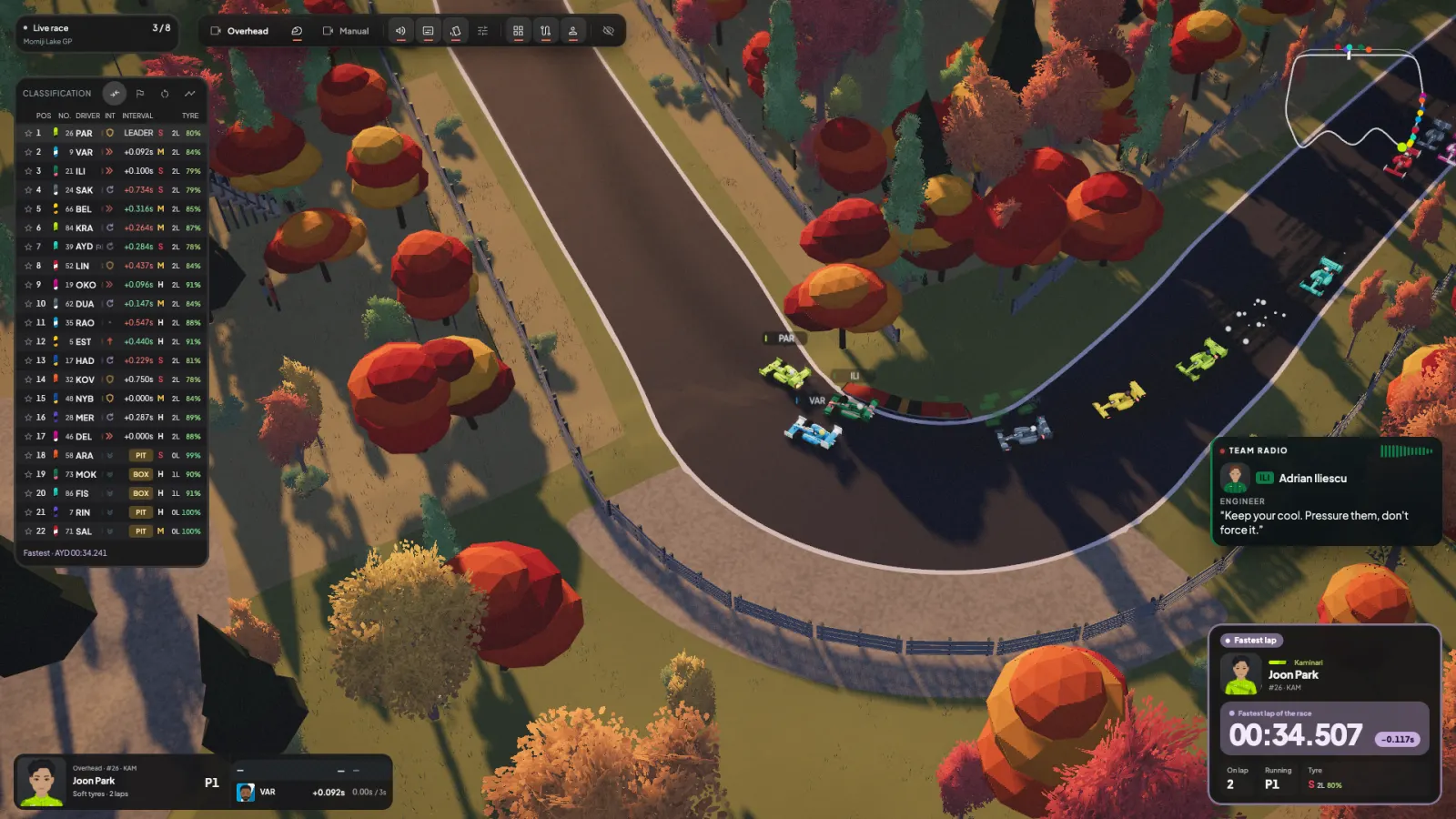
All of this shows on the broadcast. The timing tower gives every driver a compound badge, the laps on the set and a life percentage that fades from green through amber to red, with the last compounds they used beside it. The Strategy view lays each driver’s race out as a lane of stints with the planned stops still to come; the Condition view shows tyre temperatures. And the booth talks the tyres through too, from a driver surviving early in a stint on harder rubber to a set that is running out.
You never make the call yourself. Before a race you can set any driver’s starting tyre and stops in the pre-race strategy editor, but that’s a what-if: once the lights go out the computer drivers run the race and adapt the plan for themselves, and you get to watch whether your idea was any good.
The questionIn real racingIn Little EnginesWhich tyres?Several dry compounds, with a choice of three common at a weekend, plus intermediates and full wets.Soft, medium and hard, plus one wet tyre. No intermediate.How do they fade?Wear, heat and graining combine, and many tyres fall off a sudden cliff late in life.One smooth curve that steepens with wear, plus a single tyre temperature with incidents on. No sudden cliff.Who makes the call?Engineers model the race beforehand and react on the pit wall.Each computer driver picks a whole-race plan before the start, then adapts it to real wear, rivals and rain.Compound rules?Many series require two dry compounds; the details vary.Races of 9 km or more with a pit lane need two dry compounds.Rain?Intermediates and wets, with the crossover judged from lap times.One shower or a full wet race; drivers switch around a fixed grip crossover, bold ones later.Your part?Watching, or working on the pit wall.Watching it unfold. Pre-race tyre and stop settings are a what-if.
The same ideas, simplified where a broadcast needs them to be readable.
What is the difference between soft, medium and hard tyres?
The rubber compound. A soft tyre grips harder and is quicker over a lap, but it wears and overheats faster. A hard tyre is a little slower when new but lasts far longer. The medium sits in between. Teams choose between them to balance pace against how many times they want to stop.
Is a one-stop or a two-stop strategy faster?
It depends on a simple sum. An extra stop costs the time it takes to drive through the pit lane and change tyres. It pays back if fresher tyres win back more than that over the rest of the race. A slow pit lane and gentle tyre wear favour one stop; a quick pit lane and heavy wear favour two.
What is tyre degradation, and what is the cliff?
Degradation is the lap time a tyre loses as it ages, through wear, heat and the rubber changing. The cliff is the point late in a tyre’s life where the loss stops being gradual and the car suddenly drops seconds a lap. Teams plan stops to come in before it.
Does Little Engines have tyre strategy?
Yes. Every computer driver plans a whole race of soft, medium and hard stints, adapts it as the race unfolds and calls for wets when it rains. You don’t drive or run a team: you watch the calls play out on the timing tower and hear the booth react. Before the race you can set starting tyres and stops as a what-if.
Where can I get Little Engines?
Little Engines is coming to Steam for Windows, macOS and Linux. Sign up for updates to hear when the Steam page and demo open.
Take the best seat in the house.
Little Engines is coming to Steam for Windows, macOS and Linux. Get one email when the Steam page opens, one when the demo lands and one on launch day.