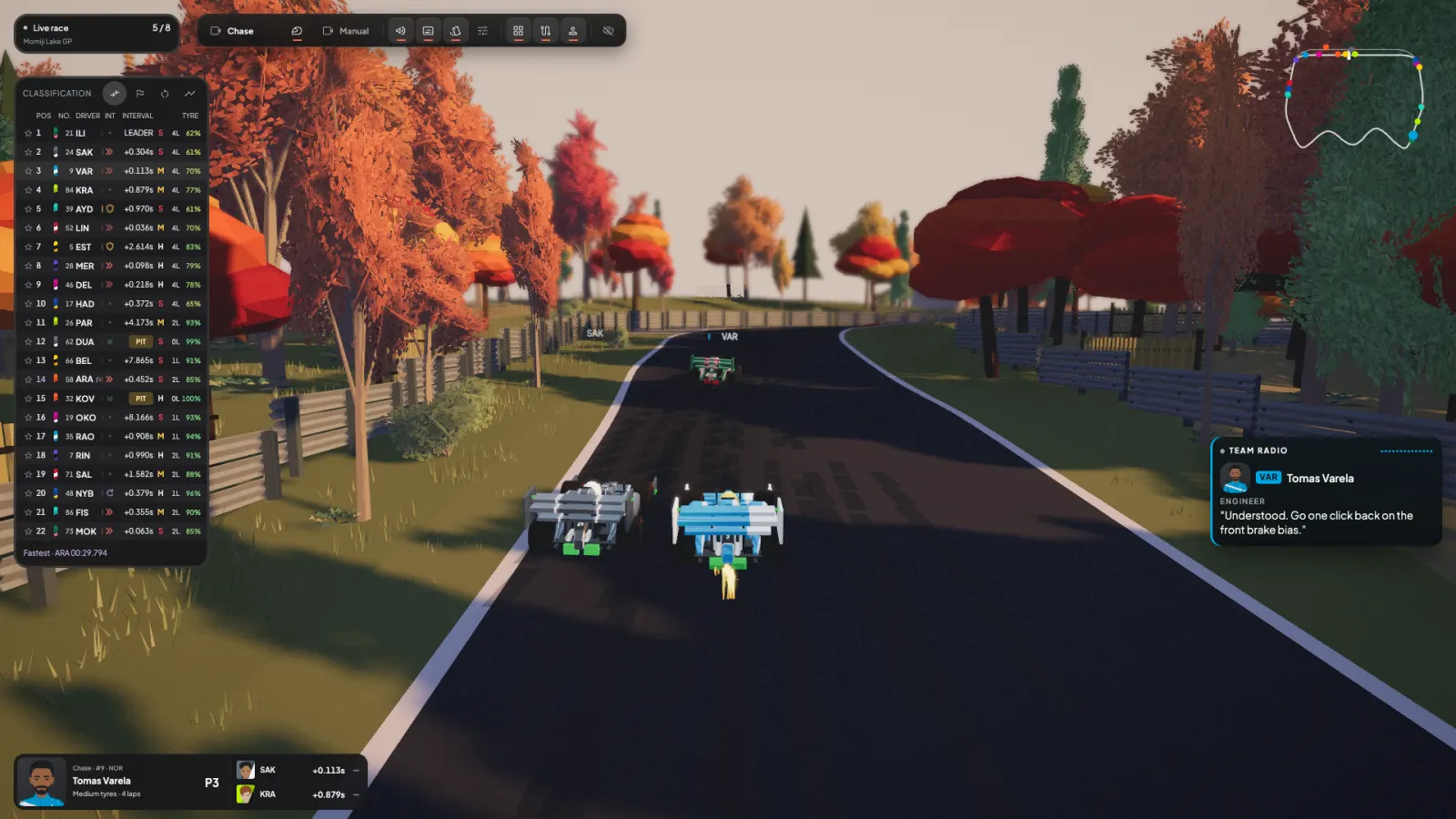
Watch two cars down a long straight and the one behind often seems to be pulled along by an invisible rope. That rope is the slipstream. It wins races on the straights, and it is also why following closely through a corner is so hard.
What it isA hole in the air behind a carThe car ahead pushes the air aside. The car behind meets less drag, so it keeps gaining speed.
Where it worksLong straights, flat outDrag grows with the square of speed, so the tow is worth most at the end of a long straight.
The catchDirty air in the cornersThe same turbulent wake robs the follower of downforce, so it slides and drops back in the bends.
In real racing
What the slipstream is
A racing car at speed spends most of its engine power fighting the air. It has to shove a wall of air out of the way every metre, and that air closes back in behind it slowly and messily. The result is a long, turbulent pocket of slower-moving, lower-pressure air trailing behind the car. That pocket is the slipstream, also called the tow, or drafting.
Drive into that pocket and the air in front of you is already moving along with the car ahead, so there is far less of it to push. Less drag means the same engine has more to give. The car behind keeps accelerating after the car in front has levelled off at its top speed, and the gap shrinks.
The wake, from aboveIn real racing · Illustration
Air parts round the leading car and tumbles in behind it. The chasing car drops into the pocket, feels the drag fall away and starts to close. When it pulls out, it keeps the run for a moment before clean air takes it back.
Why speed makes it stronger
Aerodynamic drag grows roughly with the square of speed. Double the speed and the drag is about four times as big. At low speed the air barely matters and a tow is worth almost nothing. At the end of a long straight, with the car near its top speed, almost all of the engine is being spent on the air, so a hole in the air is worth the most exactly where cars are fastest.
That’s why circuits with long straights produce tow battles and twisty ones don’t. It’s also why distance matters: right behind the car ahead the effect is strongest, and it fades away over a few car lengths as the wake breaks up and the air settles down.
Dirty air: the catch in the corners
Here is the paradox. The wake that helps on the straight hurts in the corners. Modern racing cars make much of their cornering grip from downforce: wings and the floor use the air flowing over them to press the car into the road. Those surfaces want smooth, fast, clean air. What they get behind another car is slow and turbulent, so they make less downforce.
Less downforce means less grip. The follower has to brake earlier and corner slower, its front end tends to wash wide, and its tyres slide and overheat. Commentators call it dirty air. So a quicker car can catch a slower one quickly, then find it almost impossible to stay close through a run of corners.
How bad dirty air is varies a lot between kinds of car. Cars that rely heavily on wings suffer most, and many championships have changed their rules over the years to try to make following easier.
The slingshot
Put the two halves together and you have the classic pass on a straight. The chasing car stays close through the last corner, accepting some dirty air, so it starts the straight in the tow. It builds speed in the wake, then pulls out just before the braking zone. Clean air hits it like a wall, but it already has a run of speed banked, and it carries that momentum alongside. This is the slingshot, and the move is usually finished on the brakes into the next corner.
The slingshot, step by stepIllustration
Gap8 m
Run on the leader+0 km/h
Out of the last corner, Varela slots in right behind Okonkwo.
An illustrated pass with two of the game’s drivers, not real race data. Timing is everything: pull out too early and the run fades before the corner; too late and there’s no room left to get alongside.
The tow also stacks. In a train of cars, everyone behind the leader is in somebody’s wake, so the whole queue can run closer together on the straights than they could alone. It makes trains hard to break up, and it’s why the car at the back of one is often the most dangerous: it has a tow and nobody using one on it.
Some championships go further and add overtaking aids, such as a wing that opens on certain straights to cut drag, or a short burst of extra power the driver can deploy. The details vary from series to series, but they all exist to top up the slipstream when dirty air makes it hard to get close enough to use it. For the other half of passing, the braking and the defending, see part four, on how racing drivers overtake.
In Little Engines
How the tow works in Little Engines
In Little Engines, 22 computer drivers race for real, and the slipstream is part of the physics they race on. Every car checks the cars around it every step of the simulation and takes the strongest wake it finds. It is a simpler model than real aerodynamics, built so the tow behaves in the ways you can see on a broadcast.
The wake is a narrow tube behind each car. It only acts above 65 km/h and builds to its full effect by 85 km/h. It reaches from 2.5 to 14 metres behind the car ahead, measured centre to centre, and is strongest at the near end. It is about three metres wide, weakest at its edges, and only counts if the two cars are pointing roughly the same way. The car in front also has to be doing at least 82% of the follower’s speed, so a car crawling out of an incident doesn’t hand out a tow.
At full strength the wake takes 20% off the follower’s drag, adds 5.5% to its top speed and gives it a little extra push on the throttle. Races run it at 80% of that full effect. Try it below with the game’s own numbers.
The tow calculatorIn Little Engines
Road ahead
Tow strength0%
Drag−0.0%
Top speed+0.0%
Grip, the price of the wake−0.0%
The game’s wake rule for a car directly behind and square on. The coral line is the tow at your settings; the dashed line is a straight at 240 km/h. A fast sweeper here is about an 83 m radius, a corner about 33 m.
Straights only: the corner fade
The tow in Little Engines fades out with the bend rather than switching off at a line. On anything gentler than a 200 metre radius it is at full strength. It fades through fast sweepers and is gone completely by a 50 metre radius. Each car also looks 8 and 16 metres up the road and uses the tightest bend it sees, so the tow has already faded before the braking zone instead of vanishing at it.
That last detail came from a real problem. An earlier version cut the tow at the exact point the corner began, just where cars are closest together, and the sudden loss of push made them bunch and touch. Fading it out ahead of the corner fixed it.
Where the tow lives on Kestrel Heath GPIn Little Engines
Tow the bend allows, at the chasing car100%Straight: full tow
Lap at full tow—
Lap with none—
No towFull tow
The game’s corner fade, worked out from the circuit’s simplified outline. The racing line cuts corners more gently than the outline does, so in a race the tow lasts a little longer than shown. Treat the percentages as rough.
Dirty air in Little Engines
A tow that was all reward caused trouble. Early on, a following car could hold station behind a car it had no pace to match, for lap after lap, and the field set into herds. So the wake has a price. While a car is in it, it loses up to 16% of its grip, scaled by how much tow it has. Sit in the wake into a fast bend and you give up corner speed, the gap opens, and the grip comes back. A follower has to use the tow to pass or drop back.
I should be honest about the limits. Because the grip loss rides on the same tow number, it bites hardest in fast sweepers and on the approach to corners. In a tight corner, where the tow has faded to nothing, the follower loses no grip, which isn’t how real dirty air works. There is a second effect, though: running within about 20 metres of the car ahead heats the follower’s tyres, so a long spell stuck behind someone shows up as tyre temperature. The tow itself works the engine harder, too.
How the computer drivers use it
The physics only offers the extra speed. A computer driver has to ask for it, otherwise its own speed plan would brake the car back down. On a straight, each driver raises its target speed with the tow, by up to 7.5% at full tow. Better overtakers take more of it. They stop asking a full braking distance before a corner, so a towed car doesn’t arrive too fast and run wide.
When a driver weighs up a pass, it discounts any pace advantage that only comes from the tow, because that advantage disappears the moment it pulls out into clean air. If a move is abandoned with the rival still ahead, the driver tucks back in and rebuilds the tow before trying again, rather than weaving in and out. In a queue, cars settle a little closer to the car ahead, so the tow builds down the train just as it does in real racing.
What you see and hear on the broadcast
You can see the tow working. A car in a strong wake trails little yellow sparks of disturbed air, and above a certain strength fine white streaks stream past its sides. On whichever car you’re following, the wind noise rises as it tucks into a tow. The director counts the tow too, as a small part of how it scores a fight when choosing which battle to cut to, so a car sitting in someone’s slipstream is a little more likely to get the shot. There is more on that in part five.
The booth talks about it as well. The pre-race circuit guide points out the longest straight with lines like “Watch for the slipstream here.” During the race, the analyst describes a car sitting in the dirty air of the car in front, and the lead calls it when a chaser drops out of the slipstream. In fairness, those lines are triggered by gaps and the shape of the battle, not read from the tow number itself.
Real racing vs Little EnginesSide by side
The questionIn real racingIn Little EnginesWhat makes the towA long, turbulent low-pressure wake that varies with each car’s shape.A narrow tube 2.5–14 m behind each car, above 65 km/h, with set gains to drag, top speed and push.Where it worksMostly on straights, strongest at high speed and close range.On straights, fading through sweepers and gone in corners tighter than a 50 m radius.Dirty airLost downforce in corners: less grip, tyre sliding and overheating.Up to 16% less grip while in the wake, plus tyre heat close behind. No extra loss in tight corners: a simplification.Using it to passTuck in, build a run, pull out late, finish the move on the brakes.Computer drivers ask for the tow’s extra speed, discount tow-only pace when judging a pass, and rebuild the tow after a failed move.Overtaking aidsSome series add drag-cutting wings or deployable power; the rules vary.No wing aid. Cars do carry a stored energy boost, separate from the tow.Seeing itUsually only from the gap closing on the timing screens.Wake sparks and streaks, rising wind noise on the followed car, and booth lines about the tow.
The game keeps the shape of real slipstreaming, with the tow on the straights, the cost in the bends and the slingshot pass, and simplifies the aerodynamics underneath.
FAQ
Questions about the slipstream
What is slipstream in racing?
Slipstream, also called the tow or drafting, is the pocket of slower, low-pressure air behind a car at speed. A car following closely meets less air resistance, so it can keep accelerating after the car ahead has levelled off and reach a higher speed on a straight.
What is the difference between slipstream and dirty air?
They are the same wake felt in two places. On a straight, the disturbed air behind a car cuts drag for the follower, which helps. In a corner, that turbulent air robs the follower’s wings of downforce, so it loses grip and struggles to stay close.
Why is the slipstream stronger at high speed?
Aerodynamic drag grows roughly with the square of speed, so doubling the speed means about four times the drag. The faster the cars go, the more of the engine’s power is spent pushing air aside, and the more a hole in that air is worth.
Do the computer drivers in Little Engines use the slipstream?
Yes. Every car feels a modelled wake behind the car ahead on the straights, with less drag and a higher top speed, and the computer drivers ask for that extra speed to set up passes. If a move doesn’t stick, they tuck back in and rebuild the tow before trying again. The tow fades out before corners, and running in it costs some grip.
Where can I get Little Engines?
Little Engines is coming to Steam for Windows, macOS and Linux. Sign up for updates to hear when the Steam page and demo open.
Take the best seat in the house.
Little Engines is coming to Steam for Windows, macOS and Linux. Get one email when the Steam page opens, one when the demo lands and one on launch day.