Twenty cameras, one picture, and a race that never waits. Somewhere in a dark room, one person decides what millions of fans see next. Here’s how that choice gets made, and how I taught a game to make it live.
The jobOne picture from dozens of feedsThe director watches every camera at once and cuts to the story that matters most, second by second.
The prioritiesThe lead, the closest fight, the incidentThen pit stops and the wider story, with replays to catch whatever the live picture missed.
In Little EnginesA director that listens to the boothIt cuts to the car the commentators are talking about, takes fights as they build and holds every pit stop.
In real racing
First, which race director?
A quick note before anything else, because the words trip people up. In most championships the race director is an official. They run the race itself: the flags, the safety procedures, the decisions on penalties. That job is about what happens on track.
This post is about the other one: the TV director, sometimes called the broadcast or programme director, who decides what you see of it. They never wave a flag. They choose pictures. (Little Engines muddies this a little: its camera setting is labelled “Race director”. In the game, that only ever means the cameras.)
The gallery: a wall of pictures, one output
A race broadcast is made in a gallery, a control room that is often a truck or a cabin in the paddock. One wall is covered in monitors. Each shows a single feed: fixed cameras on the corners, operators with long lenses on the straights, cameras on cranes or in the air, onboard cameras mounted on the cars, cameras in the pit lane, and the replay machines.
In the middle sit two bigger screens. Preview shows the next shot. Programme shows what is going out live. The director watches the whole wall at once, calls the next camera, and a vision mixer makes the cut. Around them, replay operators mark moments as they happen, a graphics operator puts timing on screen, and a producer keeps the bigger story in mind.
The trick is that every feed is always running, but only one is on air. Each monitor is a candidate, and their worth changes second by second.
The gallery wallIllustration
ProgrammeLeader
Every feed scores the moment. When one pulls clearly ahead of what’s on air, and the current shot has had time to breathe, the director cuts. An incident jumps the queue.
What earns the cut
There’s no rulebook, but most directors work to a similar order of priorities.
The lead comes first. The fight for the win is the spine of the broadcast, and the picture keeps coming back to it. Close battles come next, especially for the podium, and the best directors arrive before the move rather than after it. You learn to spot a car closing fast or lining up a tow, and you get there a lap early.
Incidents beat almost everything. A spin, a crash or a car slowing with smoke will take the picture from the lead without a second thought. Pit stops matter because they are where strategy becomes visible, and a stop that decides the order of the front runners is worth a full shot. Underneath it all runs the wider story: a title contender charging from the back, a team’s difficult day, a driver on a different tyre.
Then there’s pace. Cut too often and the picture feels nervous. Hold too long and you miss things. A shot needs a few seconds to settle before it means anything.
The trade-off nobody can escape
One picture means every cut is also a choice of what not to show. Hold on the leader and a pass for fifth happens off camera. Stay with that pass and the leader’s stop goes out half-seen. Broadcasts soften this with replays, which bring back what the live picture missed, with split screens and picture-in-picture, and with onboard shots that put two cars in one frame.
Graphics carry the rest. The timing tower, the gaps and the tyre information tell you about the race you can’t see. And the commentators, watching their own monitors, mostly follow the pictures: they talk about what the director has put on screen, and fill in what’s happening elsewhere from the timing. For more on the fights themselves, part four covers how racing drivers overtake, and part one covers the undercut and overcut that make pit stops worth watching.
In Little Engines
A director that listens to the booth
Little Engines has no gallery, no operators and no vision mixer. When you switch the camera to Director, one piece of code does the whole job live, for a race nobody has seen before.
The biggest difference from real television is the direction of travel. On TV, the commentators mostly follow the pictures. In Little Engines, the pictures mostly follow the commentators. When the booth starts a line about a driver, that driver takes the picture, within a few rules that stop it cutting too often. The booth also talks about the car on screen, its place and the gap ahead and behind, so the conversation goes both ways.
The rules are the ones a human director keeps in their head. A new subject holds the picture for at least ten seconds. Urgent calls still wait five seconds after a cut, unless it’s contact, a retirement or the winner. A line about the leader takes the picture once the current shot has had its minimum. And if an urgent call interrupts a story that’s still live, such as a fight, the picture can go back to it afterwards.
One stretch of race, two ways to watch itIllustration · In Little Engines
On screen—
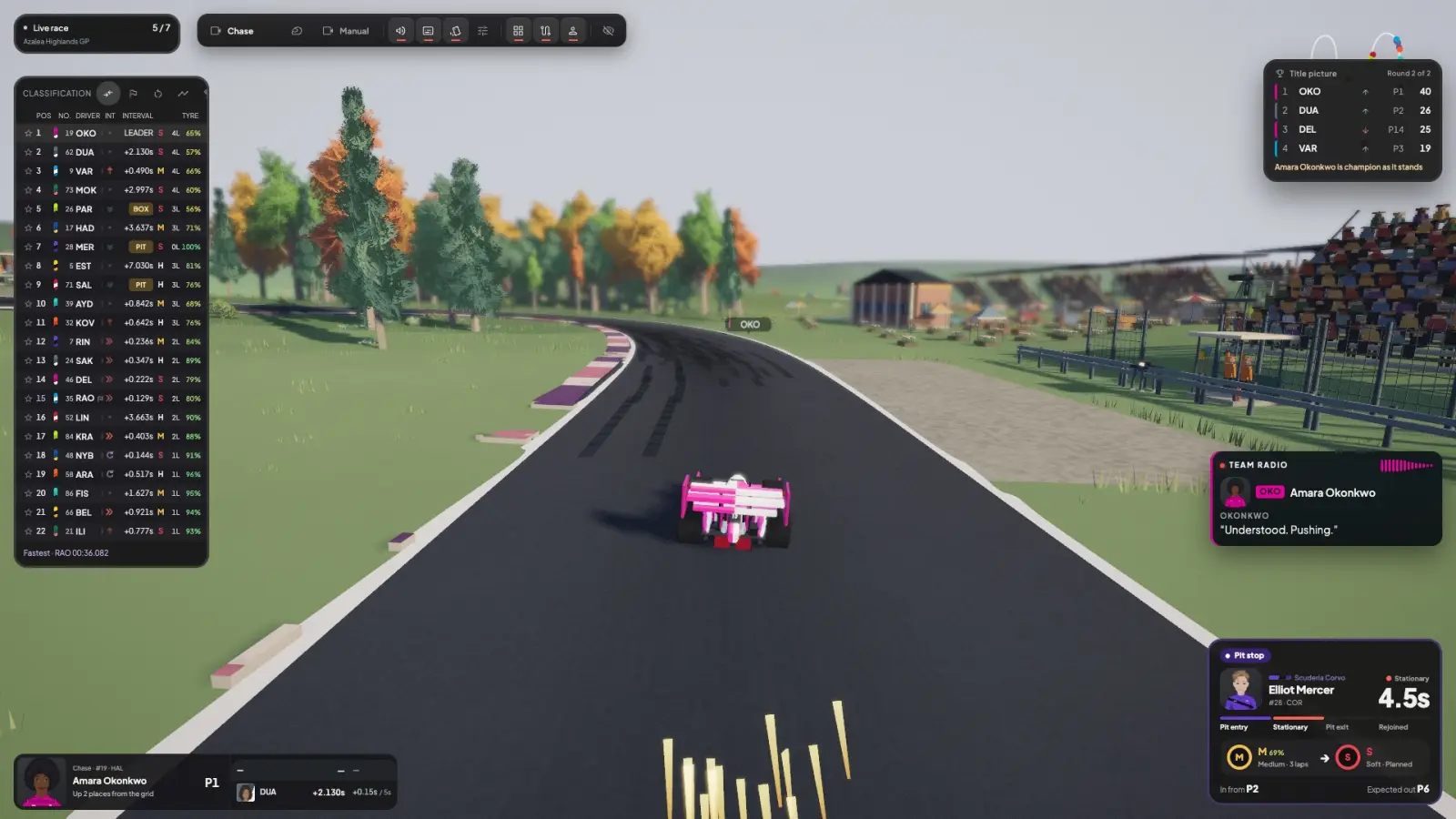
On Director, the picture follows the booth and the building fight, then stays with a car through its whole stop. On Free camera it stays on the driver you picked, and the story inset offers the fights you’re missing.
Taking the fight before the pass
A human director spots a fight brewing from experience. The game measures it. For every pair of cars running nose to tail, it scores the pressure many times a second from five things: how close they are on the road, how fast the gap is closing, whether the car behind has committed to an attack or the car ahead to a defence, how much tow the car behind is getting, and what the place is worth. A fight for the lead counts for more than one for twelfth, and a driver you’ve starred counts a little more again.
A fight becomes tense once its score passes a threshold and stays there for most of a second. Once tense, it stays tense until the score falls well below that line, so the picture doesn’t flicker between two fights. When the picture is free, the director takes the most tense fight, on the car behind, whose view has both cars in it. To keep the camera from chasing every scrap, fights below eighth place only count if the booth has just mentioned one of the drivers, and these cuts are never closer than 25 seconds apart.
Build a fight and watch it scoreIn Little Engines
Intent
Tow
FadesTense
The weights here are the game’s own. A fight turns tense at 0.5 and, once tense, stays that way until it drops below 0.3. Closeness counts for nothing beyond 22 metres.
Fights the main picture isn’t showing still get seen. The story inset, a small picture in the corner, is offered the most tense fight off screen, so the battle for sixth can play out while the main picture stays with the leader. It’s my version of the director glancing at another monitor on the wall.
Between stories, a dwell timer keeps the picture moving. No car holds it much beyond twenty seconds, or twelve on Onboard, unless it’s in a fight within a second or has just changed places. When the time is up, the director goes to a starred driver who’s been off screen a while, then a live fight, then someone near the front it hasn’t just shown. By default, Top-five focus keeps all of this on the top five starters and whoever is running in the top five now; switch it off and the whole field is fair game.
Pit stops are shown in full
Real directors often cut away from a stop once the car is stationary. I decided the game shouldn’t. Once the car on screen enters the pit lane, the picture stays with it until it has rejoined, and for two and a half seconds more to see it settle back into the race. The camera goes to Overhead for the whole visit, because a stop reads best from above.
The pit-stop holdIn Little Engines
Pit entryInto the lane
StationaryTyres change
Pit exitReleased
RejoinedBack on the racing line
+2.5 sSettled, picture free
Picture held · Overhead
A line about another carHeard in full. The picture stays on the stop.
A lead change in the stop waveMostly the stop itself. The picture stays.
Contact in the top threeOne of the few calls that may take the picture.
Final lap or the winnerThe race being decided always may.
The four stages are the ones on the game’s own pit-stop card. While the hold lasts, only an incident at the front, the final lap, the winner or your own pick can take the picture away.
Angles, replays and your hand on the camera
The director also picks the angle. It rotates between Overhead, Trackside and Onboard, with Overhead as the natural home view, and keeps any angle for at least eight seconds. On a long hold on one car, it still freshens the view every fifteen seconds or so, as a real broadcast does between cuts. Trackside only comes into the rotation at circuits with trackside cameras, and battles are taken from Overhead or Trackside so both cars are in frame. The fourth camera, Chase, is yours: the director never picks it.
Your choice always wins. On Director, picking a driver from the timing tower moves the picture straight away, and the director leaves it there for a while: no building fight takes the picture for twelve seconds. Switch to Free camera and the picture stays on whichever driver you select. Turn off automatic camera angles and the angle stays yours too.
And when the director misses something, there are replays. Every finished session saves itself as a replay, which plays back in the full broadcast. The scrub bar marks the laps and the big moments, such as damage, retirements and the fastest lap, and jumping to one lands a few seconds early so you see the build-up. The race plays out exactly as it did. Only the watching is new.
Real racing vs Little EnginesSide by side
The questionIn real racingIn Little EnginesWho picks the picture?A TV director in a gallery, calling cuts to a vision mixer, with a team around them.One piece of code, running live through the race, when the camera is set to Director.Who leads whom?The pictures lead. The commentators mostly follow what’s on screen.Mostly the booth. A line’s subject takes the picture, and the booth also describes the car on screen.Spotting a fightExperience, instinct and a lot of monitors.A score from road gap, closing speed, intent, tow and the place at stake, many times a second.Pit stopsA judgement call. The picture often cuts away mid-stop.Shown in full from Overhead, from pit entry until 2.5 seconds after the car rejoins.What gets missedCaught later in replays, split screens and picture-in-picture.Offered to the story inset live, and kept in a replay of the whole session.Viewer controlUsually none, beyond the occasional onboard feed.Director or Free camera, any driver, any of the four cameras.
The game borrows the director’s priorities, then makes some choices a human crew wouldn’t, such as never leaving a stop halfway.
The best seat, chosen for you or by you
Of everything in Little Engines, the director is the piece I’m proudest of and least finished with. A human director has years of instinct. Mine has a set of rules, a tension score and a booth to listen to, and every race teaches me another moment it should have caught sooner. When it lands, though, it feels like the real thing: the picture is already on the fight when the booth calls the pass.
The TV director, sometimes called the broadcast or programme director, watches every camera feed at once and decides which single picture goes out live. They call each cut, ask for replays and onboards, and balance the fight for the lead against battles, incidents and pit stops elsewhere on the circuit.
Is the race director the same as the TV director?
No. In most championships the race director is an official who runs the race itself: flags, safety procedures and penalties. The TV director runs the pictures. The two work in the same paddock, but one decides what happens on track and the other decides what you see of it.
How does a race broadcast decide which battle to show?
Mostly by what the fight is worth and how close it is to becoming a pass. A battle for the lead or the podium beats one further back, a car closing fast beats one sitting in the gap, and an incident beats almost everything. Good directors cut to a fight before the move, not after it.
Does Little Engines have an automatic camera director?
Yes. Switch the camera to Director and it cuts to the cars the commentators are talking about, takes fights while they build, holds every pit stop until the car rejoins and varies the angle between Overhead, Trackside and Onboard. Switch to Free camera and the picture stays on whichever driver you pick, because the game is about watching rather than driving.
Where can I get Little Engines?
Little Engines is coming to Steam for Windows, macOS and Linux. Sign up for updates to hear when the Steam page and demo open.
Take the best seat in the house.
Little Engines is coming to Steam for Windows, macOS and Linux. Get one email when the Steam page opens, one when the demo lands and one on launch day.