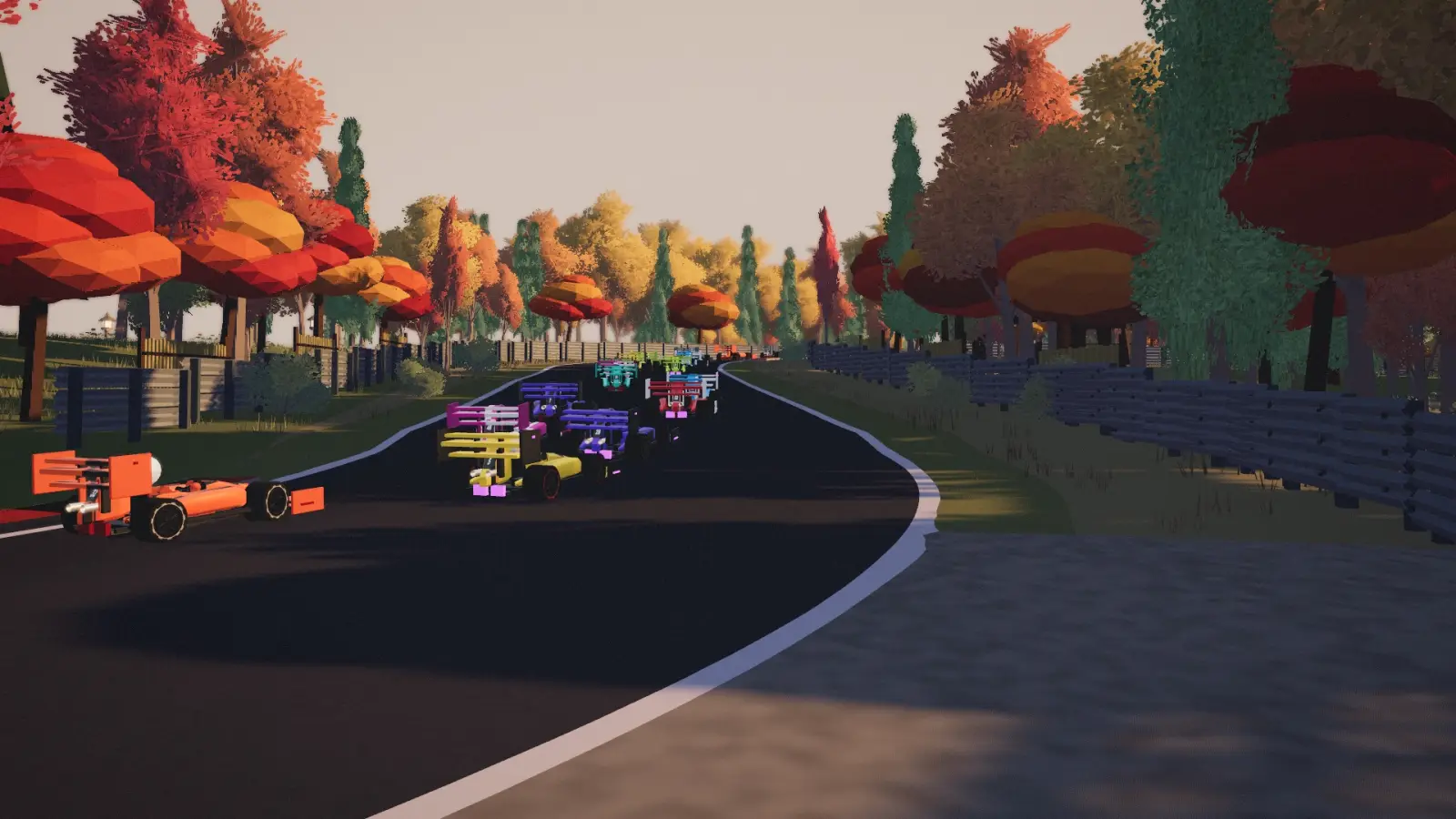
Some of the best races I’ve ever enjoyed, I watched from the sofa. Little Engines is a racing game built around that feeling: sit back and watch it all unfold. Here’s why I made it, and what it took.
What do you do?Watch it all unfold.Let the director cut to the battle or take the cameras yourself, with a live booth calling every move.
Who’s racing?Twenty-two computer drivers.Each with their own style and temperament, racing each other for real.
Who writes the story?Nobody. The race does.Tyres, strategy, weather and rivalries decide it, so no two races play out the same.
Most racing games ask one thing of you: drive. Find the braking point, hit the apex, beat the car in front. I love those games. But they leave out something I love just as much, which is watching a race unfold.
Little Engines is a racing game built for that second feeling. It's a race broadcast simulator: twenty-two computer-driven cars race for real, and you get the best seat in the house to watch it all unfold. I make it on my own, and this is the first of three posts about why it exists and where it fits among racing games.
The view from the sofa
Watching a race well is its own pleasure. You spot the car three seconds back that is quietly lapping faster. You wonder whether the leader's tyres will last. You see the defence that holds for ten laps, then the move that finally sticks. None of that needs your hands on a wheel. It needs a good race and a good way to see it.
The trick is seeing all of it. From any one car you get two mirrors and a radio. The fight for the lead happens somewhere up the road, and you hear about it afterwards. Try it below.
One seat or every seat
Director’s pick
The battle on track
The broadcast finds the closest fight and cuts to it.
Illustration: eight drivers from the Little Engines grid lapping Kestrel Heath. Switch to the cockpit to see how much of a race one seat hides.
A race is a story, not a lap time
When people talk about a great race afterwards, they don't quote lap times. They talk about what happened: the start where someone gained three places, the strategy gamble that came good, the rain that arrived with five laps to go. A race has chapters.
A driving game turns those chapters into a backdrop for your own lap. I wanted a racing game where the race is the story, and where the story is different every time because nobody writes it. Here's the shape of one.
One race, five chaptersIllustration · 20 laps
Rinaldi’s gap to the leadOut of reachOn the gearbox
Lap 1Lights outJoon Park gains three places before the first braking zone.
Lap 7Staying outAmara Okonkwo goes long on hard tyres while the leaders pit.
Lap 10The undercutMatteo Rinaldi pits early and starts to reel in the leader on fresh rubber.
Lap 15Rain at turn 4The track turns greasy. Who gambles on wets first?
Lap 19Last-lap lungeRinaldi is on the leader’s gearbox with a lap to go.
Illustration of how a race story builds. In the game, live timing, tyre wear and the commentary booth tell you which chapter you are in as it happens.
What I kept, and what I left out
Building a racing game around watching forced a question: what does it need when the whole point is to see the race? My answer was to keep everything that makes a race worth watching and cut everything that would pull your eyes away from it.
Kept
The race itself, run for real by 22 computer drivers
Broadcast cameras, and the choice of where to point them
A two-voice commentary booth calling it live
Timing, tyres and team radio, so you can read the race
Championships where form and rivalries carry over
Replays of every race you watch to the flag
Left out
Scripted moments that fire whatever the race does
A team of your own to root for by default
A garage, a budget or a staff list
Car upgrades and research trees
A steering wheel: the cars drive themselves
Letting the race tell its own story is the hard part
A race that unfolds on its own sounds simpler to make, especially for one person. It isn't. When you drive, a game can lean on you: you are the drama, and the other cars only need to give you something to beat. With nobody to lean on, four problems land on the game at once.
Most of the work in Little Engines goes into those four problems. Drivers have ratings and a temperament, so a patient tyre specialist and a late-braking chancer race differently. The race runs on real tyre wear, pit stops and weather, so the drama is earned. The director watches every gap and cuts to the fight. And the booth follows all of it live.
Little Engines is a one-person studio, so every one of those problems has landed on my desk: the drivers, the director, the circuits, the booth and this website. Watching a race I didn’t script turn into a proper story, called live by the booth, is the part I’m proudest of.
Who a spectator racing game is for
If you've ever left a race on in the background and found yourself leaning in for the last ten laps, it's for you. If you love the strategy and the storylines more than the driving, it's for you. And if you've ever wanted to rename the grid, repaint the cars and see how a season plays out, the Paddock is waiting.
It isn't trying to replace driving games, and you don't have to choose. Little Engines just takes the other seat: the one where you can sit back and watch it all unfold.
Next in the series: people often file Little Engines next to motorsport management games. Part two explains why it isn't one.
FAQ
Questions about a racing game you watch
Is there a racing game where you just watch?
Yes. Little Engines is a race broadcast simulator built around watching. Twenty-two computer-driven cars race for real on forty-three fictional circuits, and you choose how to see it: let the broadcast director cut to the action, or follow any driver from the Overhead, Trackside, Chase or Onboard cameras.
Can I drive in Little Engines?
No. Every car is computer-driven, so you can sit back and watch it all unfold. The game is built around the broadcast: the cameras, the commentary booth, live timing and the story of the race.
Is Little Engines a management game?
No. You don’t run a team, hire drivers or develop a car, and none of the cars is yours. You can set the grid and tyre plans before a race as a what-if, but once the lights go out you’re watching. Part two of this series covers the difference.
Are the races scripted?
No. Every race is decided on track by the drivers’ ratings and temperament, their cars, tyre wear, strategy and the weather. Run the same race twice and you’ll get a different story.
Which platforms will Little Engines be on?
Little Engines is coming to Steam for Windows, macOS and Linux, designed for keyboard and mouse.
Take the best seat in the house.
Little Engines is coming to Steam for Windows, macOS and Linux. Get one email when the Steam page opens, one when the demo lands and one on launch day.